


A clip-on hair system is the no-glue way to wear a hairpiece. Small clips under the base grab your own hair, so there's nothing stuck to your scalp and nothing to shave. It's a great fit for some guys and a poor one for others, and it mostly comes down to one thing: how much hair you've got for the clips to hold.
When someone asks us about clip-ons, the questions are nearly always the same. Will it fall off? Will it hurt my own hair? Can I sleep in it? Let's take them one at a time.
The quick answers
- What it is: a partial hairpiece with clips sewn underneath. No glue, no tape, no shaving.
- What it needs: healthy hair around the thin spot for the clips to grip. It won't work on a bare scalp or a bare front hairline.
- Day to day: on in the morning, off at night. No sleeping or showering in it.
- The main risk: clips that pull in the same spots every day can thin your own hair over time.
- How long it lasts: most hair systems start to wear after about three months, clip-on or not.
What is a clip-on hair system?
It's a partial hairpiece, sometimes called a clip-in hair system, a clip-on toupee or a clip hair patch, that holds on with small pressure clips instead of tape or glue. It sits over the thin area, usually the top or the crown, and its hair blends into the hair around it.
Don't mix it up with clip-in extensions. Extensions add length or fullness to hair you already have. A clip-on system covers the spot on top where your hair has thinned. New to all of this? Start with what a hair system is.
How do you put on a clip-on toupee?
Each clip is a tiny comb with a snap. Most men's pieces have four of them, sewn under the edge of the base. You slide each one into your own hair close to the scalp, usually at the sides and back, then press it shut so the teeth grip. The front edge often isn't clipped at all; it just rests at your hairline.
It takes a little practice at first, then a few minutes each morning:
- Start with clean, dry hair. Comb it back from the area you're covering.
- Open all the clips under the base.
- Place the front at your hairline or a little behind it, so your own hair softens the edge. If your piece has a front clip, snap that one first.
- Clip the sides, then the back. Press each clip until it snaps shut, pressing down on the piece rather than pulling it.
- Give it a gentle tug in a few spots. If it moves, re-seat that clip.
- Comb your own hair over the edges so it hides the clips and the two blend.
Your own hair around the piece needs a little length for this, so it can cover the clips.
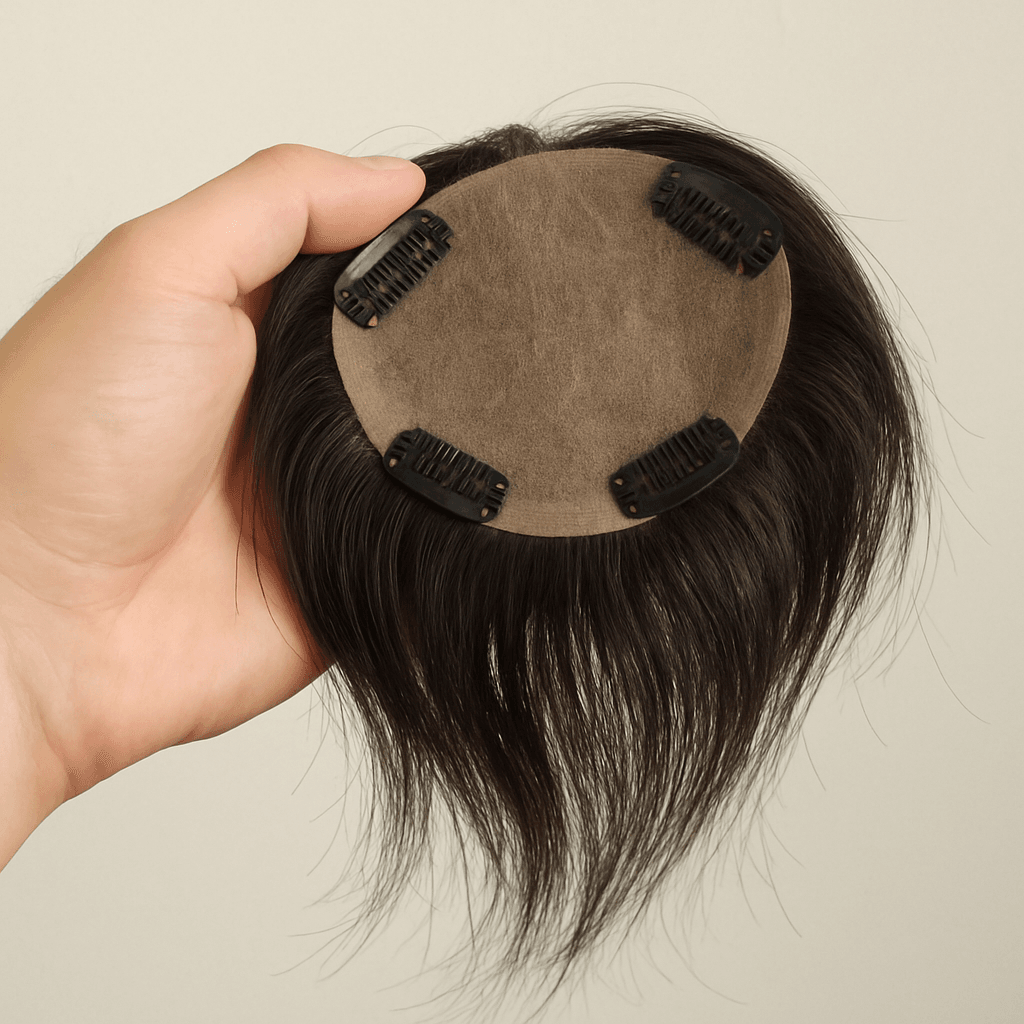
Clip-on pros: what's good about going glue-free?
The big one is control. You decide when you wear it, and nothing is stuck to your skin. For a lot of guys, that makes it an easy first step.
- No glue, no residue. Nothing to scrub off, and nothing on your scalp if your skin doesn't like adhesives.
- No shaving. A bonded piece needs a clean, shaved area underneath. A clip-on just sits on your hair.
- Your scalp gets a break every night. You wash your own hair and scalp as normal.
- Easy to undo. Change your mind? Just stop wearing it.
- Fewer salon visits. There's no regular re-bond. A good first cut-in still makes a big difference to how natural it looks, though.
Clip-on cons: what's the catch?
A clip-on depends on the hair you've got left. If the hair where the clips sit is fine or sparse, they won't grip well, they might show, and the piece can feel loose.
- It's less secure than a bond. Fine for work and a normal day. Not for swimming, contact sports or anything that pulls at your hair.
- It's a daily routine. Taking it off at night means putting it back on every morning.
- Clips can show or be felt. With fine hair, the wind can lift a section and show a clip. A clipped edge also feels firmer to the touch than a bonded one.
- No bare hairline. Clips need hair to hold, so a clip-on can't sit right at a front hairline that has no hair. Most clip-on wearers keep some of their own hair in front of the piece. If there's no hair at the front, some add a small piece of tape there, but at that point it's a hybrid, not a true clip-on.
Is a hair system safe?
For most people, yes, as long as you watch for two things. Which one applies depends on how yours is attached.
With clips, watch your own hair. Clips that tug the same small bundles of hair every single day can lead to traction alopecia, hair loss from constant pulling. The American Academy of Dermatology lists it as a cause of hair loss that can become permanent, and says easing the pull helps prevent it. So:
- Snug, not sore. If a clip aches, it's too tight or holding too little hair.
- Move each clip a few millimetres now and then, so the same hairs aren't always taking the weight.
- Take it off every night.
- Watch the clip spots. If the hair there starts looking thinner, stop clipping there.
With tape or glue, watch your skin. Some people react to adhesives. Redness or itching from an adhesive is a form of contact dermatitis, according to the American Academy of Dermatology. Tell your stylist about sensitive skin before your first bond.
Either way, if thinning, redness or soreness doesn't settle, please consult a dermatologist or doctor.
Clip-on vs tape vs glue: which one suits you?
It depends on how much hair you've got, how active you are, and whether you want to wear it day and night. Clips suit partial thinning and part-time wear. Tape and glue suit full coverage and wearing it around the clock.
| Clip-on | Tape | Glue (liquid adhesive) | |
|---|---|---|---|
| How it holds | Clips grip your own hair | Double-sided tape on the scalp | Adhesive bonded to the scalp |
| Own hair needed | Yes, around the area | No | No |
| Shave under the base | No | Yes | Yes |
| Sleep and shower in it | No, take it off daily | Yes | Yes |
| Swimming and hard exercise | Not a good idea | With care | Yes, with a sweat-resistant adhesive |
| Front hairline coverage | Only if your own hair is in front | Yes | Yes |
| Daily effort | On and off every day | Low between re-tapes | Low between visits |
| Upkeep | Clean the piece, check the clips | Clean and re-tape as the hold fades | Clean and re-bond, usually every 2–4 weeks |
| Main thing to watch | Pull on your own hair | Edges lifting with oil and sweat | Skin reacting to the adhesive |
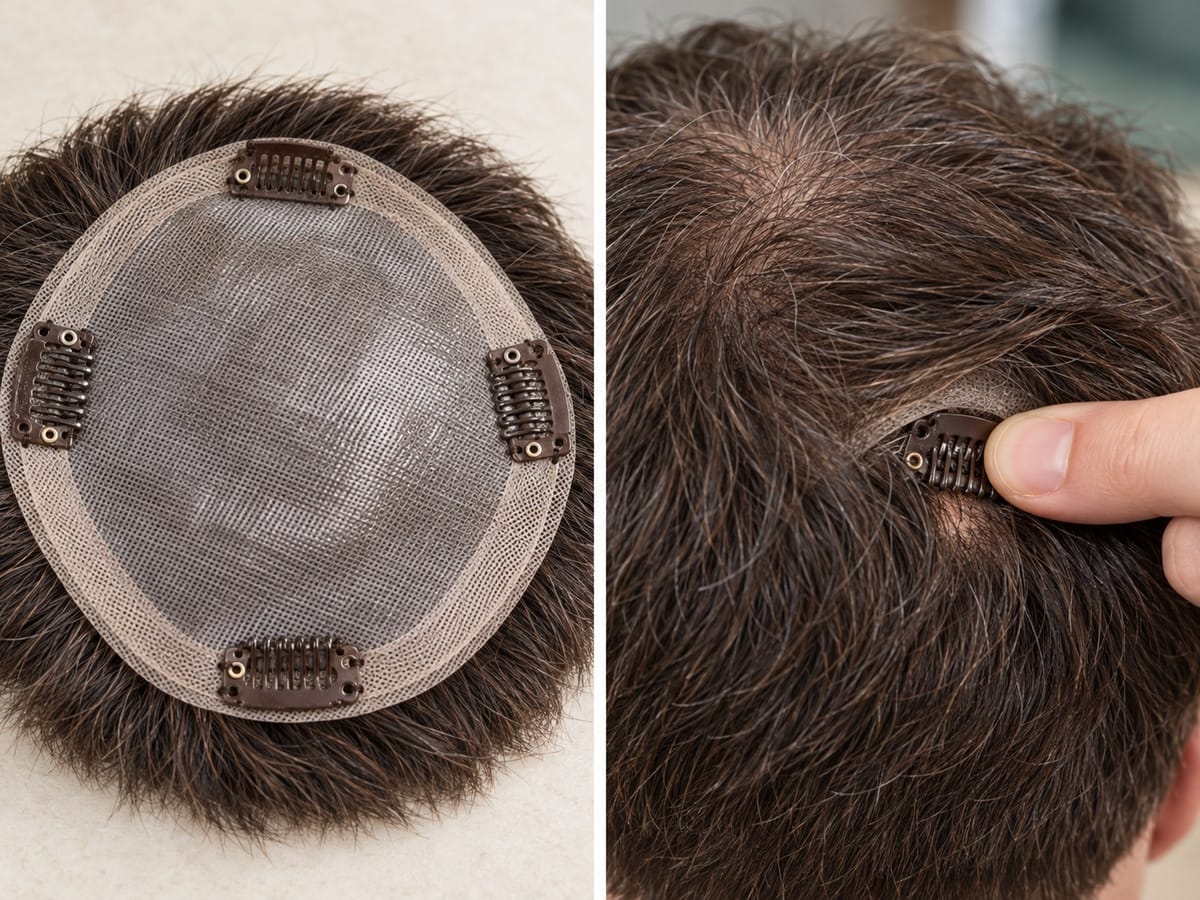
Left: the snap clips sewn under the base. Right: pressing a clip shut on a small section of your own hair. Your hair then gets combed over the edge to hide it.
Leaning toward bonding? Read how hair system tape works and our guide to tape, glue and tools.
Will a clip-on stay put?
Through a normal day, yes: walking, driving, a breeze, a hat on and off if you're careful. How secure it feels comes down to how many clips there are, where they sit and how much hair each one holds. That's why the same piece can feel solid on one guy and loose on another.
Where it struggles is anything that pulls or soaks your hair: swimming, contact sports, a heavy workout. If those are part of your week, a bonded piece is the safer bet. And get into the habit of a quick tug test before you leave the house.
Can you sleep or shower with a hair system?
It depends on how it's attached.
- Clip-on: no. Take it off before bed and before showering or swimming. Sleeping in it tangles the hair and strains the hair the clips are holding, and water loosens the grip.
- Tape or glue: yes. A bonded piece is made to stay on through sleep, showers and the gym. It comes off for a clean and re-bond every 2 to 4 weeks.
Who is a clip-on right for?
A clip-on suits you if you've got thinning or partial loss with healthy hair around it, you only want to wear coverage some of the time, or you can't or won't use adhesives. It's an easy way to try hair replacement without shaving or booking regular re-bonds.
It's probably not for you if:
- your front hairline is bare (a bonded hairline piece blends better there)
- the hair around the thin spot is very fine or thinning too, so clips won't grip
- you want to sleep, shower, swim and train in it
- your hair loss covers most of the top and crown
If it's only your hairline or only your crown, a small bonded piece is the other way to go. Our online store doesn't sell clip-ons, but it does have a frontal hairline piece ($199 as of November 2026) for a receding hairline and a 5"×5" crown piece ($179) for thinning on top. For help with sizes, see full cap vs partial hair systems. For women, we cover clip-in and bonded toppers on our women's hair replacement page.
Holiday Sale: until Jan 15, every hair system in our online store is 20% off the regular prices on this page, taken off at checkout. Salon prices aren't part of the sale.
How do you look after a clip-on?
It's easier than a bonded piece because there's no glue to deal with. The hair on it still needs gentle handling, though:
- Wash it off your head with a mild, sulfate-free shampoo, and keep conditioner on the lengths.
- Pat it dry and let it air-dry on a stand. Never roll it up damp.
- Check the clips. If one no longer snaps shut firmly, replace it before it lets go.
- Brush from the ends up with a wide-tooth comb.
Most of the hair systems we fit start to wear after about three months, and then it's time for a new one. Taking a clip-on off every night saves it a little wear, but sun, washing and handling still take their toll. More on that in how long a hair system lasts.
Clip-on or bonded: which should you get?
Go clip-on if you want control and like having your own hair and scalp free at night. Go bonded if you'd rather forget about it for weeks at a time and live in it day and night. Both can look natural. The real difference is your routine and how much hair you've got to clip to.
At Hair System Salons in Huntington Beach, we fit clip-on pieces as well as full systems and hairline or crown pieces. A fitting for a full system or a hairline or crown piece is $250 and takes about 2 hours. That covers cutting the piece to you and blending it into your own hair, and it includes pieces you bought somewhere else.
Bottom line: if you've got a good amount of hair around the thin spot and you like the idea of taking it off at night, a clip-on is a gentle way to start. If your hairline is bare or you want to swim, train and sleep in it, go bonded. Not sure which you are? Book a free 30-minute consultation. We'll look at your hair together and talk through your options, the upkeep and the cost, and there's nothing to buy. Still comparing bases and sizes? Try how to choose a hair system, or see all our hair system services.
Sources and further reading
- American Academy of Dermatology: hair loss, who gets it and causes: traction alopecia from hairstyles that keep pulling on the hair.
- American Academy of Dermatology: contact dermatitis: skin reactions to things that touch the skin, including adhesives.
Frequently asked questions
How much hair do you need for a clip-on hair system?
Enough healthy hair around the thin spot for every clip to grip firmly. Clip-ons work for thinning on top or at the crown, but not on a bare scalp or a bare front hairline, because there's nothing for the clips to hold.
Is a hair system safe?
For most people, yes. With clips, the thing to watch is your own hair, since constant pulling in the same spots can cause traction hair loss. With tape or glue, it's your skin, since some people react to adhesives. See a doctor if thinning or irritation doesn't settle.
Can you sleep or shower with a clip-on toupee?
No. Take a clip-on off before bed and before showering or swimming. A bonded piece, held with tape or glue, is the one you can sleep and shower in.
Can clip-on hair systems damage your own hair?
They can if the clips are too tight or always sit in the same spots. Keep them snug, not sore, move them a little now and then, and take the piece off every night.
How long does a clip-on hair system last?
Most of the hair systems we fit start to wear after about three months, clip-on or not, and then you replace it. Taking it off at night saves a little wear, but sun, washing and handling still age the hair.
Do you sell clip-on hair systems?
Our online store sells bonded pieces, not clip-ons. At the salon we fit clip-on pieces as well as full systems and hairline or crown pieces, and we can help you decide which suits your hair at a free consultation.
Shop the pieces in this guide
Human hair units from our online store. Every unit can be fitted at the salon in Huntington Beach.


