


Remy hair vs virgin hair answers two different questions. Remy is about how the hair was collected: the cuticles were kept and all point the same way, root to tip. Virgin is about what was never done to it: no dye, bleach, perm or relaxer. A strand can be both, either or neither. On a hair system you wear every day, the whole unit, base and hair, wears out in about three months, whatever the hair label says.
It usually comes up when two units look the same but cost very different amounts, like the standard and Remy thin skin units in our store. Most pages on this question are written for extensions and wigs, and the definitions below hold for those too. If you're shopping for a topper or wig, our women's hair replacement page covers what we do in the salon; our online store sells men's hair systems.
The short answer
- Remy: the hair was gathered so every strand faces the same way. It says nothing about colouring.
- Virgin: the hair was never chemically processed. It says nothing about direction unless it also says Remy.
- "Human hair": real human hair. On its own, it doesn't promise Remy or say how the hair was treated.
- On a hair system: about 3 months of daily wear, then it's replaced. The 3-month clock is the same whatever the hair label.
- In our store: two of our 30 hair systems are labelled Remy, none are labelled virgin, and the Remy version of the same base costs $20 to $180 more (November 2026).
What is the difference between Remy and virgin hair?
Remy is a collection method; virgin is a processing history. So Remy vs virgin hair isn't a contest between two grades, and hair labelled "virgin Remy" claims both. You'll often read that all virgin hair is Remy. That's a seller's habit, not a definition.
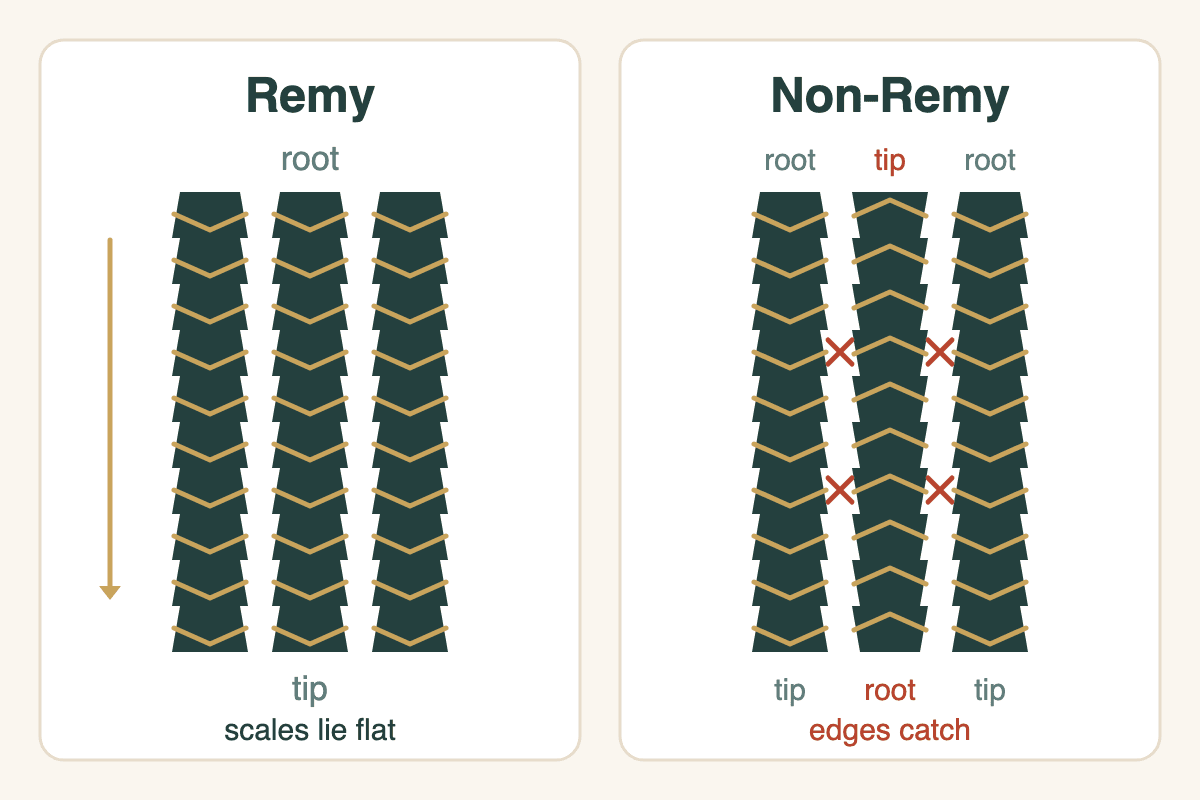
Why direction matters comes down to the cuticle, the outer layer of each hair. A review in the International Journal of Trichology describes it as overlapping scales "like shingles on the roof", and explains that the shape and orientation of those scales cause the difference in friction along a hair. When neighbouring strands all point the same way, the scales lie flat against each other. When some are upside down, the edges catch.
Remy hair vs human hair: what does each label promise?
Is Remy hair human hair? Yes. "Human hair" names the material, and "Remy" adds one promise on top: the strands were kept facing one way, root to tip. That's the whole difference on a label, and "human hair" is the one you'll see on most hair systems, including 28 of ours:
| Label | What it tells you | What it doesn't tell you |
|---|---|---|
| Human hair | It's real human hair, not a made fibre | Which way the strands face, or what was done to them |
| Remy | The strands were kept facing one way | Whether it was coloured or processed |
| Non-Remy | The seller isn't claiming one direction; usually it means mixed | What was done to make it behave |
| Raw | A seller's word for unprocessed hair; sellers often say it's from one donor | Anything you can check; there's no shared standard |
"Human hair" with no Remy claim means the seller isn't promising Remy. It doesn't tell you either way how the hair was treated. If it matters to you, ask the seller what they know.
Don't judge any hair by how soft it feels in the bag. A review in the International Journal of Trichology notes that silicones are the most used hair conditioner, and that different silicones wash out at different rates, so a new feel isn't a reliable test, whatever the label says.
Raw vs virgin hair
Raw hair is a seller's word for virgin hair that has had even less done to it; there's no shared standard for where virgin ends and raw begins. Treat it as a description, not a grade.
How long does Remy or virgin hair last on a hair system?
About three months of daily wear, the same as any unit; then it's replaced, not repaired. You'll see figures like 6 to 12 months for Remy or a year or more for virgin from wig, extension and hair system sellers alike. None of them fits a system that's bonded and worn day and night, and our own Remy thin skin unit's product page says "Around 3 months with care". The unit, not the hair label, sets the lifespan.
Our guide to how long a hair system lasts explains that clock, and what a hair system is covers the basics if you're new.
On a hair system, the 3-month clock comes first, whatever the hair label.
What do our own hair labels say?
Of the 30 hair systems in our store, 21 are labelled "Human hair", 7 "Human hair, Grey hair" and 2 "Remy human hair". None is labelled virgin or raw. Every one is sold with 5 in (12.7 cm) hair.
What the Remy label is meant to buy is hair whose strands start out facing one way, so the scales lie flat, as in the diagram above. Our product listings call that "a smoother feel", and this guide doesn't claim more than that. The two Remy units share their base with a standard unit, so you can see what the label costs (regular prices, November 2026):
- Thin skin (same 0.08 mm base): $180 more for Remy. The standard thin skin (HS1) is $269; the Remy thin skin (HS1R) is $449.
- Full Swiss lace (same base): $20 more for Remy. The standard Swiss lace (HS7) is $459; the Remy Swiss lace (HS7R) is $479.
A daily wearer goes through about four units a year, so the Remy label adds about $720 a year on the thin skin, or about $80 on the Swiss lace. For a whole year's budget, see what a hair system costs.
Holiday Sale: until Jan 15, every hair system in our online store is 20% off the regular prices on this page, taken off at checkout. Salon prices aren't part of the sale.
What you give up with a Remy unit is choice:
- Thin skin: 12 shades on the Remy unit, 36 on the standard one.
- Swiss lace: 4 shades on the Remy unit, 49 on the standard one.
- Grey: neither Remy unit lists a Human Grey (HG) shade. Check the shade list on the product page rather than the "Grey hair" label.
If you have grey at the temples, start with the standard units. Our guide on how to choose a hair system explains colour codes and grey.
A small gap on a base you already like is reasonable. If the gap is big, put the money toward the right colour and density instead.
You can browse thin-skin hair systems or lace hair systems. If you're shopping for your first human hair toupee, our toupee buying guide compares lace, thin skin and mono.
Is virgin hair better than Remy hair?
Not automatically. Virgin hair hasn't been coloured before, so a colourist starts from a clean slate. But hair systems are sold by shade code, ours included, so for most buyers the real choice is the shade, not the word "virgin". We don't sell units labelled virgin.
Can Remy and virgin hair be colored?
Yes. Both are human hair, so both can be coloured. Hair that's already been coloured has had chemical work done, and lightening it further means more of it. The American Academy of Dermatology notes that lightening hair more than three shades needs stronger peroxide, which causes more damage. That's why we look at a unit before we promise a colour. Colouring a unit from our store ends its return, so decide on the shade first.
In our salon, colour is $45, about 30 minutes, or $145 together with a maintenance visit.
How do you read a supplier's hair label?
You can't see Remy or virgin hair, so read the label as a claim and check what you can, on any store's page, ours included:
- Ignore letter grades. We know of no shared standard behind 7A, 8A or 10A, so one seller's 10A isn't another's.
- Ask what a claim is based on. The FTC's advertising guide for small businesses says advertisers need evidence for their claims, and that catalog sellers should ask the maker for it rather than just repeat it.
- Judge what you can check. Base, size, density, colour code and whether grey shades are offered tell you more about how a unit will look than the hair label.
Want a second opinion on a label before you order? Email us at info@hairsystemsalons.com.
Can we look at a unit's hair for you?
Weighing a Remy unit against a standard one? Bring either one, or just the product links, to a free 30-minute consultation and we'll look at them with you. Thuy La has worked with hair systems since 1994. The first fitting is $250, about 2 hours, for a unit from our store or one you bring, and first-timers can do the consultation and fitting the same day. You're in a private suite in Huntington Beach, there's no contract, and we're open Monday to Saturday, 9am to 5pm. Book a free consultation.
Bottom line: pick the base, colour and density first, then decide whether a $20 or $180 label gap is worth it to you. Ready to compare bases? Start with our toupee buying guide.
Sources and further reading
- Gavazzoni Dias, "Hair cosmetics: an overview", International Journal of Trichology, 2015: the cuticle's overlapping scales, why their direction affects friction, and how silicone conditioners work.
- American Academy of Dermatology, "Coloring and perming tips for healthier-looking hair": how colouring, lightening and perming damage hair.
- Federal Trade Commission, "Advertising FAQ's: A Guide for Small Business": why product claims need evidence, including claims a seller repeats from a maker.
Frequently asked questions
Does Remy hair shed less on a hair system?
We can't promise that it does: the label doesn't change how the hair is tied into the base. Check a new unit dry, out of the box, before it's cut, washed or worn. If hairs come away when you gently comb it, email info@hairsystemsalons.com with photos within 48 hours of delivery.
Is a Remy unit worth it for a first order?
We wouldn't start there. Your first unit is how you learn your density, colour code and base, and the next one can change any of them. Our two Remy units cost $449 and $479 (November 2026), come in 12 and 4 shades, and neither lists a Human Grey shade. Once a standard unit suits you, try the Remy version of the same base if you want to compare.
Where do Remy and virgin hair come from?
The label rarely tells you. Our product pages don't name a country or a donor, and we don't claim one. If a seller does, ask what the claim is based on. A country name on its own doesn't tell you how the hair was collected or treated.
Same base, two hair labels
Human hair units from our online store. Every unit can be fitted at the salon in Huntington Beach.


